


Having successfully found out how to get a bell perfectly in tune, Taylor’s were able to produce carillons. The definition of a carillon is a minimum of 25 stationary bells spanning two octaves. In 1904 they made a small experimental 40-bell carillon at the bellfoundry. They made a two-octave carillon for Appingedam in Holland in 1911 and in 1913 replaced the Dutch Vlissingen (Flushing) carillon destroyed by a fire with 39 bells. After WWI, they made a 39 bell three-octave carillon for Armagh Cathedral in1920 and a 49 bell four-octave carillon for Rotterdam in 1921 with a 4 ton ‘bourdon’ (largest bell). Between 1922-1926 they produced carillons sent to the US for Gloucester, Andover, Birmingham in Alabama, Morristown, New Jersey and Philadelphia and they supplied 32 bells for Cape Town City Hall in 1923. A lot of work!
Meanwhile, Cyril Johnston from the Gillett & Johnston company (G & J) in Croydon that made tower clocks and some bells, took over the bell production in 1902, aged 18. When he was a bit older, he was described as being “dashing” and “debonaire” a womaniser and a social climber who loved wining and dining influential contacts. Denison Taylor was none of these things! A confirmed bachelor, he was often short tempered with difficulty in keeping domestic staff, but he had a very good product to sell.
Cyril lived with his sister and his French mother, and visitors were encouraged to stay the night, with lavish hospitality. Businesswise, Cyril promised delivery dates that were impossible, put in low quotes, and then asked for an increase in the cost for untoward work or a rise in the cost of bellmetal. He acquired a new Taylor bell and cut it in half from top to bottom to give him a shortcut in improving the profile of his bells. He bought a small tuning machine in 1906 and a slightly larger one in 1909. In 1921 he entered the carillon market.
In New York, Frederick Mayer, organist and choirmaster at the West Point Military Academy, became a consultant for the oil billionaire John Rockefeller Junior to provide a carillon for the Park Avenue church that Rockefeller had built costing 1.5 million dollars. On one of his visits to the US, Denison Taylor met Mayer and told him bluntly that only Taylor’s made good carillons and Cyril didn’t know what he was doing!
Nevertheless, Mayer asked Taylor’s and G & J for a quote for a 35-bell carillon. He told Denison that this order could lead to all sorts of things. Denison sent Mayer his standard pricing, but Cyril undercut Denison’s quote by 20%. In October 1922 Mayer signed a contract with Cyril for a 43-bell carillon with a 4.75-ton bourdon bell, the largest bell that Cyril could tune, with an impossible delivery date of 9 months.
No carillon had been produced by December 1923, but Rockefeller and his family visited London and he and his wife travelled to Loughborough to hear the Taylor 1923 War Memorial carillon with 49 bells and a bourdon bell weighing 5 tons. Rockefeller was extremely impressed and sent Denison a congratulatory letter the next day. Meanwhile, Mayer had signed a new contract with Cyril for a 53-bell carillon with a bourdon bell over 20,000lbs / 10 US tons. To overcome the problem of space at the Park Avenue church the eight largest bells were put on the roof. Cyril managed to get King George V and Queen Elizabeth to inspect the bourdon bell erected in his works, but when the carillon was installed in October 1925, wealthy neighbours objected strongly and the smallest bells were not very audible. There had been a huge dispute when the carillon arrived, as the company that were installing it complained bitterly that none of the bells were numbered and there were no bolts to fix the bells to the girders. It was inaugurated in December 1925 and Mayer immediately wrote to Denison apologising profusely that Cyril had turned up with hundreds of brochures promoting G & J that included the claim that he had personally rediscovered the lost art of tuning perfect bells.
Mayer was not too worried about the neighbours because Rockefeller was building a huge, gothic revival church as big as a cathedral, in the New York ‘Riverside’ area. The tower was 392 feet high with a belfry measuring 40ft x 40ft and 50ft high. Mayer, now a “carillon architect”, decided that there was room for a monster carillon with a new bourdon bell weighing over 40,000lbs / 20 US tons and three more bells larger than the Park Avenue bourdon bell, a combined weight of 60 tons. Additional new bells at the top end made a 72-bell six octave carillon. Mayer then asked Cyril to recast the top 28 bells from Park Avenue.
In 1927 Taylor’s installed a 49-bell War Memorial carillon at Albany City Hall, and a 49-bell carillon with a 10-ton bourdon bell in Florida, judged to be a state-of-the-art “reference” carillon, and a similar one in Indianapolis. In 1928 a large 49-bell carillon was inaugurated at Sydney University.
Mayer had asked Denison to give him a quote for the four large bells, as there had been a lot of friction between Cyril and Rockefeller’s accountants who disputed rises in the cost. I’m sure Denison was not at all keen to extend a G & J carillon and he would need a new case and core plate for the new bourdon bell that was going to be about 10ft in diameter. He did work out a price that was a lot less than Cyril’s quote, so Mayer told Cyril he had to match Denison’s price and throw in some extra metal!
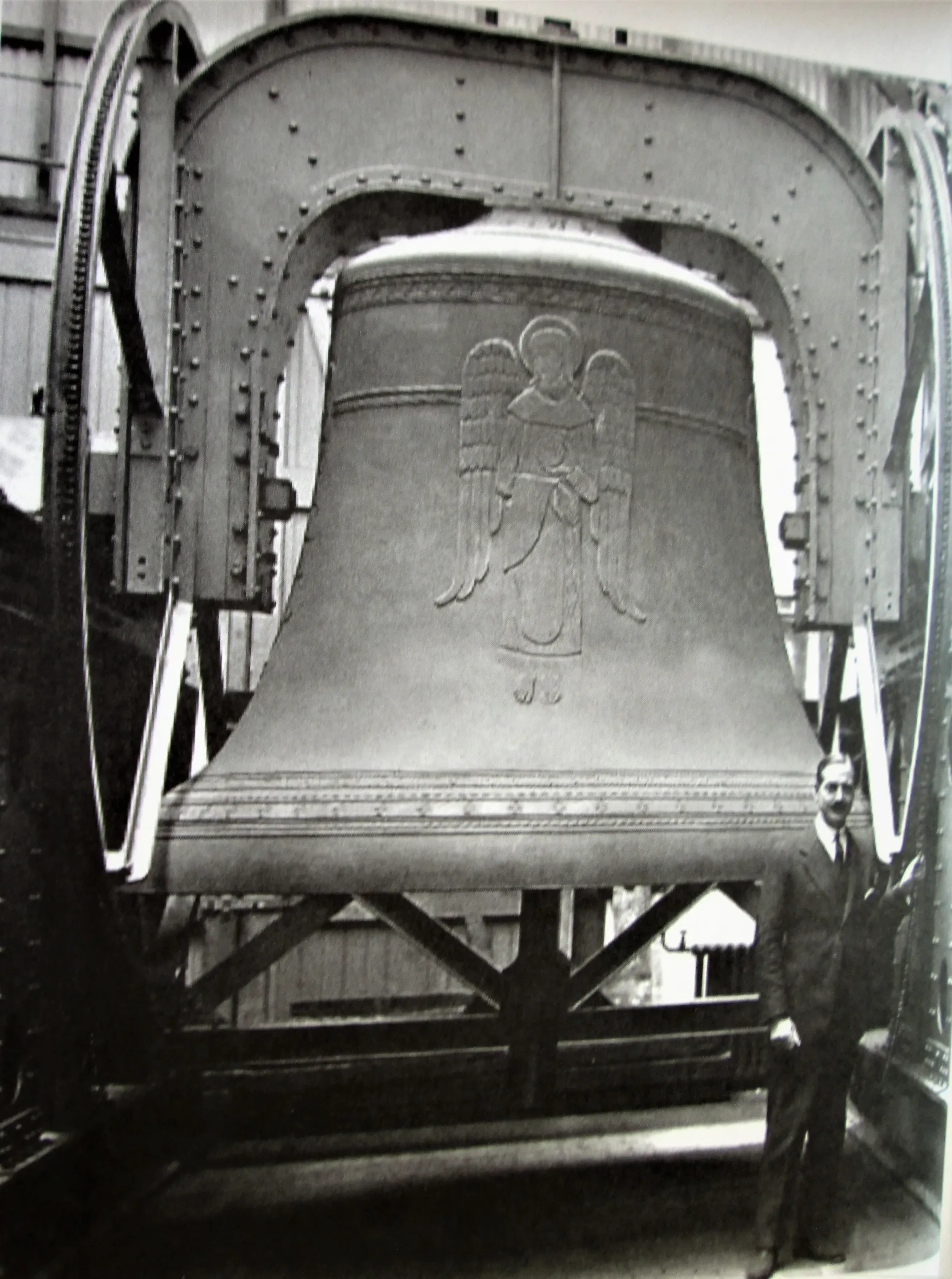
The Gillett & Johnston’s maximum furnace capacity was “about 10 UK tons” so they rented space in a bronze foundry at Deptford in London where bells over 10 tons were moulded and cast. They were taken to Croydon to be tuned on a very large tuning machine that Cyril bought when the John Warner bellfoundry shut in 1925. Cast in December 1927 the finished weight of the new bourdon bell was 40,920lbs / 18.27 UK tons / 20.46 US tons. In very large bells there can be a “rogue” note that the ear hears, also known as a “metallic 4th”. Mayer rejected this bell in June 1928 that was still on display in their works because of the “rogue” note, and he had asked a famous carillonneur for his opinion. A heavier bell was cast in Spring 1929 and a bell heavier than this one in January 1930, reputedly “nearly” 48,000lbs as cast, so 21+ UK tons before tuning. When it had been tuned, Mayer decided that the first bell was the best of the three! Instead of four big bells he only wanted three to make more room in the tower.
In 1929 Taylor’s provided a 47-bell carillon for St. Helens in Lancashire, and in the 1930s they provided carillons in the US at Michigan University, Duke University, Rumson, Richmond, Hartford, Lincoln Nebraska, Ann Arbor and Luray where there were some famous caverns. A three-octave carillon for Bathurst in Australia was in the works waiting for the tower to be finished.
Rockefeller had asked Mayer if there was any problem with the bells at Riverside being too high? Installed in 1931, this did prove to be a real problem so he asked Cyril to re-tune the top 37 bells to make them louder. The bourdon bell was 10ft 2ins in diameter but the smallest bell was only 5ins. There had been more disputes over Cyril’s final price, but they agreed to pay him what he was asking for if he took the 37 bells back to Croydon, but he didn’t do this. Meyer then asked for 37 new bells instead. In 1936 he asked Cyril to re-tune 61 of the 72 bells and he would be paid to do this, but WWII then stopped this happening. In 1948 Cyril resigned over a financial dispute, and he died in 1950. The casting of bells stopped in 1957.
I have detailed most of the carillon work that Denison obtained and I imagine he was very glad that he didn’t get the Park Avenue and Riverside jobs.
Photo: Cyril Johnston from Gillett & Johnston, Croydon, standing beside the 18 ton ‘Riverside’ New York bourdon bell for the 72- bell carillon in 1928.
-Mike Milsom