


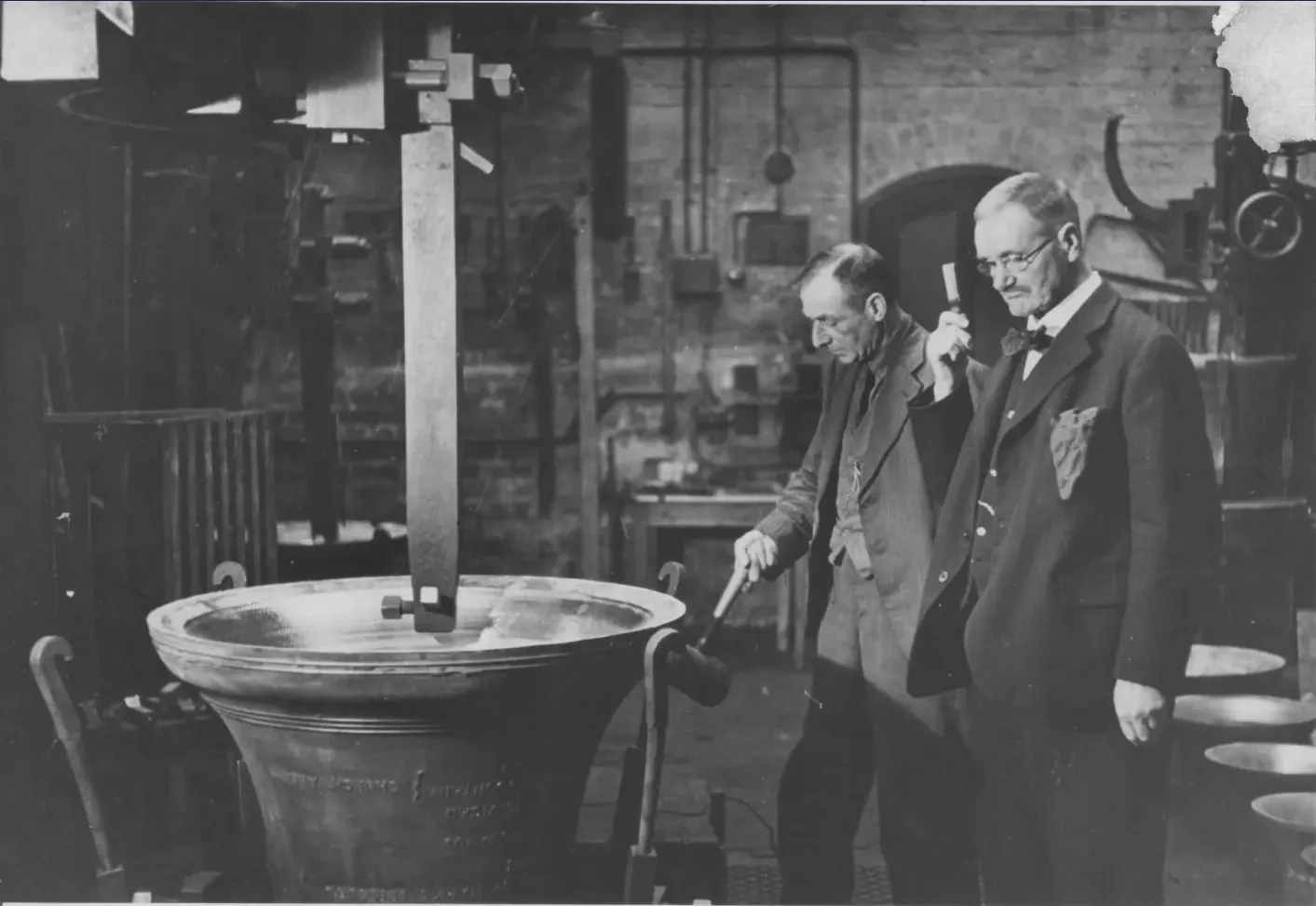
In 1894, with alterations to the inside profile of their bells, John William Taylor I (1827-1906) and his son John William Taylor “Junior” (1853-1919) were very close to finding out how to get the first five notes (partials) in tune, but they needed to have tuning forks to find the exact frequencies. Valentine & Carr (V & C), 76 Milton Street, Sheffield, were late 19th century instrument makers and their work from circa 1870-1930 included tuning forks that were considered to be very accurate.
Frequencies were expressed as being cycles per second (cps) or Hertz (Hz) from 1930, in honour of the German physicist Heinrich Hertz. On July 25th 1894, JT ordered 51 forks 4Hz apart from 340Hz-540Hz at 9 shillings 8 pence each and they quickly ordered more.
(As a comparison, the weekly wage of a labourer working 60 hours over 6 days a week was about 13 shillings).
The tuning forks were large ones with a thread at the bottom with a washer and a nut to mount them on resonator boxes that greatly increased the volume and the time the forks were audible.
The joinery shop made the resonator boxes to V & C specifications made of pine, as “light in weight wood” helps the loudness level.
Each box was a different size closed at one end with the frequency painted on them. “Beats” are a pulsing sound between a known reference frequency such as a tuning fork, and a frequency to be determined, such as partials in a bell. Counting beats determines the exact frequency. If a 400Hz tuning fork and a 408Hz tuning fork give equal beats of 4Hz per second, the partial in the bell is 404Hz.
For very large bells with slow beats from the low frequencies, the exact frequency could be determined by counting the beats using the second hand of a clock and Taylor’s had a large Victorian clock for this purpose.
The forks were used almost exclusively until 1988 and for a number of years after this along with other tuning aids.
-Mike Milsom