


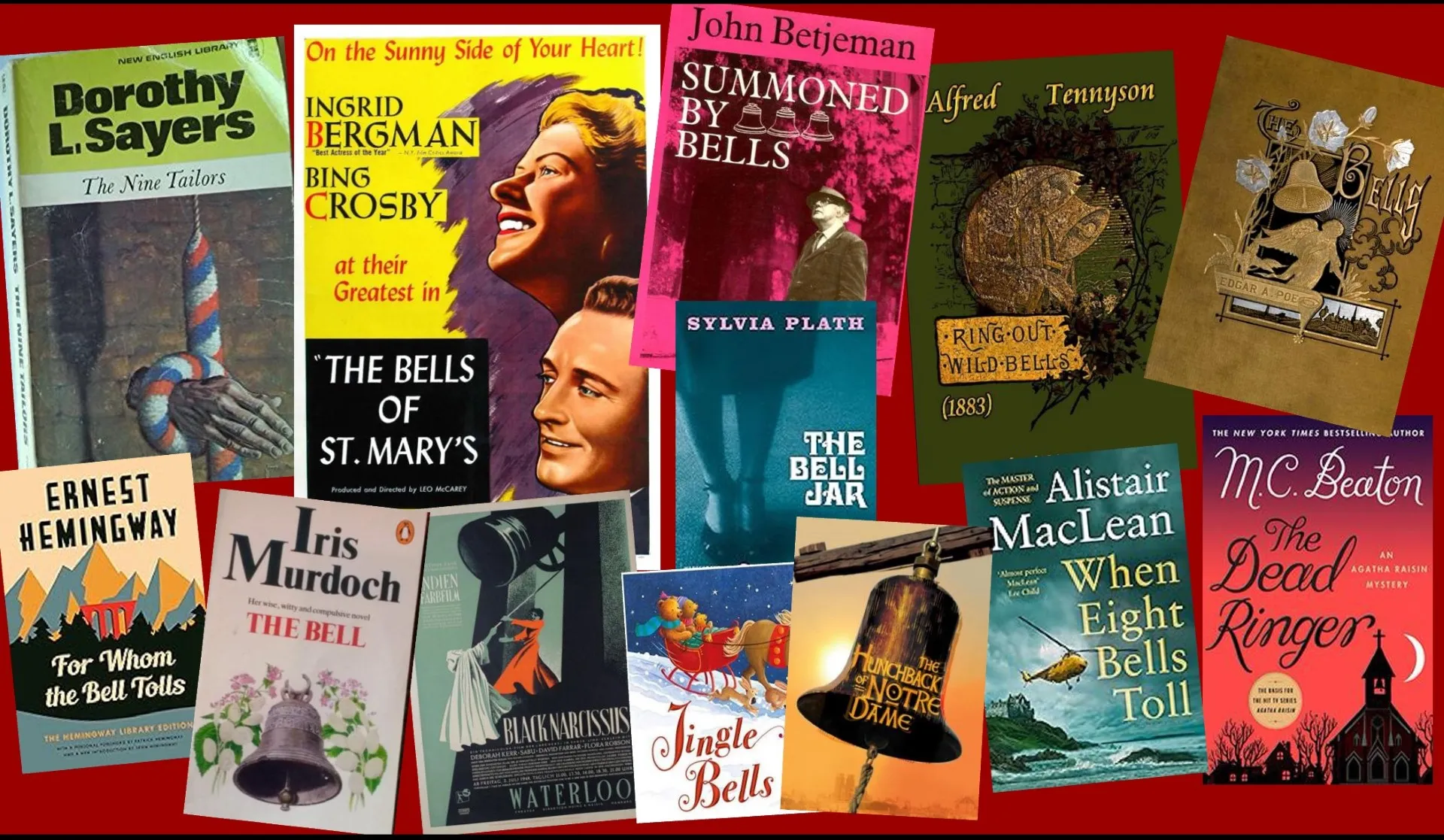
Bells have featured prominently in many works of fiction, often used by authors to symbolise themes of celebration, warning, memory, mystery and time passing. That said, many writers like Thomas Hood perceived bells as rather sinister, often as harbingers of death. however, even Hood still managed to introduce some black humour into one of his verses:
“His death, which happen’d in his berth, at forty-odd befell
They went and told the sexton, and the sexton toll’d the bell.”
Bells may sometimes be employed to facilitate character development. For instance, in Victor Hugo’s ‘The Hunchback of Notre-Dame,’ Quasimodo (the deformed bellringer) is largely defined by his relationship with the cathedral bells. Other books where bells play a key role include ‘Black Narcissus’ by Rumer Godden and Ernest Hemingway’s ‘For Whom the Bell Tolls’ which focuses on the idea of bells tolling for the dead in order to explore themes of war, death, and sacrifice.
The art of change-ringing in mathematical patterns known as methods – originated in 17th-century English churches and remains largely an English phenomenon. It is therefore strange that it is rarely reflected in English literature. Poets such as Tennyson in ‘Ring out, wild bells’ or A.E. Housman in ‘On Bredon Hill’ referred to the sounds of change-ringing in their work but not in any depth. Other poets have felt drawn to the world of campanology including Edgar Allan Poe (The Bells) Jean Ingelow (High Tide on the Coast of Lincolnshire) and Thomas Gray (Elergy written in a Country Churchyard). Bells did however play a pivotal role in the poetry of John Betjeman. In ‘Monody on the Death of Aldersgate Street Station’ he talked of drowning in “the roaring flood of a twelve-voiced peal from (St.) Paul’s.” Elsewhere, in his poem, ‘Bristol’, he even cited change-ringing terminology illustrating ‘the mathematic pattern of a plain course on the bells.’ In his poem Christmas he is more frivolous with:
…And sleepless children’s hearts are glad. And Christmas-morning bells say ‘Come!’
Even to shining ones who dwell safe in the Dorchester Hotel.”
It is also significant that partly to reflect the way he was frequently drawn to the beauty and mystery of parish churches, he chose to call his verse autobiography ‘Summoned by Bells.’
Perhaps the most famous literary bells in popular fiction remain those that feature in Dorothy L. Sayers’ detective novel, ‘The Nine Tailors.’ Sayers’ novel personifies the bells of Fenchurch St.Paul with the names of; Gaude, Sabaoth, John, Jericho, Jubilee, Dimity, Batty Thomas and even the curiously named, Tailor Paul. Sayers describes with reasonable accuracy the complex patterns of ringing methods. One of these methods is pinpointed by her sleuth, Lord Peter Wimsey, as the basis of a cipher which turns out to be crucial to the plot. Several of her fellow crime writers have also been inspired to use bells in their novels such as Christopher Bush in ‘The Case of the Seven Bells (1949) and George Bellairs in ‘Toll the bell for Murder’ (1955). In more recent times we have had the ‘Bell in the Lake’ by Lars Mytting (2019) (part of a trilogy exploring Norwegian folklore and mythology) which focusses on two bells forged in the 16th century said to possess supernatural powers.
Several TV screen writers have shown an affinity with bell ringing. It featured in TV’s Mission Impossible (episode: ‘Church bells in Bogotá’) as well as in two of M.C. Beaton’s Agatha Raisin books, in Midsomer Murders as well as an episode of Father Brown.
-Mark Temple