


This article traces the development of furnace design at Taylor’s from the 16th century to the present day.
Written by Mike Milsom
1540 – The Reverberatory Furnace
In 1540, an Italian expert on metallurgy, Vannoccio Biringuccio, published De la Pirotechnia (Concerning Pyrotechnics).
He advocated a method of melting metal where the fire was not in direct contact with the metal and a small wall separated them. Curved walls and a curved roof reflected the flame onto the metal, and this design became known as a “Reverberatory” (reflected flame) furnace.
1786–1821 – Robert Taylor’s Early Years
Robert Taylor (1759–1830) went to work for Joseph Eyre in St. Neots.
In 1786 he owned the foundry and a sketch shows a conical structure that was a reverberatory furnace.
Robert moved to the Taylor foundry in Oxford in 1821 but before he left, he had cast 149 bells.
1839–1858 – The First Loughborough Foundry
In 1839, the order for the recasting of the Loughborough Parish Church bells stipulated that they had to be cast “in or near Loughborough”, so John William Taylor, Robert’s son, built a foundry in Pack Horse Lane with a 20-year lease.
By now, the design of reverberatory furnaces had been improved with a short “railway” type tunnel with an arched roof. They were built in the open yard beside the foundry wall, and the tunnel went into the foundry through the wall so that they could load in the metal and brick it up from inside, known as “wall furnaces”.
Just before the tunnel went through the wall there was a hole in the roof and a tall chimney. This sucked the flame over the metal and the time to melt the metal using coal instead of wood was considerably reduced.
In 1858 the Mears (Whitechapel) foundry was still using wood, and it took 22 hours to melt the metal to cast “Big Ben.”
1859–1875 – Cherry Orchard and Early Expansion
John William died in 1858 when his son John William Taylor I was age 32, and with the lease about to run out, he moved to the present ‘Cherry Orchard’ location.
The new works had a substantial open yard with buildings against the walls with two coal-fired furnaces, and 172 tons of bells were cast from 1860 to 1869.
The largest furnace was called a “5-ton” one, but this is the maximum capacity and you should never load this amount of metal in. The design wasn’t very good and they rebuilt the chimney twice as metal losses were too high.
The smaller furnace was about 1.75 tons capacity, but they rebuilt it to be 2 tons.
For the Preston Town Hall 4-ton hour bell in 1867 nearly 5 tons of metal was put in the main furnace, but it wouldn’t get up to the right temperature. With fingers crossed, they poured the metal into the moulds, but the bell and the moulds were scrap.
To recast it they used both furnaces together and also when they cast the 4.2-ton Worcester Cathedral hour bell in 1868.
They also started using the largest furnace for a second cast in the afternoon and sometimes a third one in the evening, and from 1870 to 1875 they cast 210 tons of bells.
1875–1881 – Larger Furnaces and Great Paul
By 1875 they were totally running out of space and they built the main foundry for bells and cast iron with a 5-ton and 7-ton furnace for bells. They could use these together and tonnage from 1876 to 1880 was 305 tons.
Everything was fine until 1881 when, reluctantly, they had to agree to cast the enormous bell “Great Paul” for St. Paul’s Cathedral which was going to weigh about 17 tons, so they built the third 12-ton furnace.
20 tons of metal were loaded into all three furnaces and on Wednesday, November 23rd they started melting the metal.
John William II was 28 in 1881 so together with his father and the foundry manager they juggled with all three. I assume that they gently lit the new 12-ton furnace about 11am, three hours before the 5-ton and 7-ton ones, as the normal melting time for these was about 8 hours.
They were all at the right temperature at 10.30pm so they opened all three, with a gutter from each one going into a single channel and filled the mould in just four minutes.
1891–1940 – Four Furnaces in Operation
In 1891 they built a 2-ton furnace alongside the other three, and the sensible capacity was now about 22 tons. All four furnaces are still there today and from 1900–1909 they cast a total of 710 tons.
The three largest furnaces were not used at the same time until 1940, when “Great George” was cast for Liverpool Anglican Cathedral and they used the 2-ton furnace as well.
Altogether, they melted 23 tons of metal spread between all four and cast the bell at 8pm.
1977–1988 – Diesel Conversion and Tilt Furnaces
In 1977 I rejoined Taylor’s and the Foundry Manager left in 1979. A relatively young man, Roger Johns, was promoted but his workload went up substantially.
We both worked out which bells we were going to cast because in the tuning office there was a ledger with every diameter bell listed, the plates put on the crook (strickle), and the “as cast” weight.
Sometime previously the 2-ton furnace had been converted to burn diesel oil with a large air blower. The flame was blasted over the metal and I took over lighting the furnace and adjusting it so Roger didn’t have to do this.
Every time I increased the air and diesel I went into the street and looked at the top of the chimney. If there was a slight trace of black smoke this meant that there was unburnt diesel, so there was no way that the metal could oxidise.
Furnace losses were between 2.5% to 3% and the time it took to heat the metal ready to pour was only three and a half hours.
When bellmetal is about 1,100°C the top of the metal looks like tadpoles in a pond. Robert Taylor described this as “little things swimming and spinning round at the top of the metal, ready to cast”.
When it needed re-lining in 1983, we increased the capacity to 2.4 tons and when I left Taylor’s in 1988, a crucible “tilt” furnace was in use, ideal for small carillon bells.
1992–Present Day – Modernisation
In 1992 Taylor’s were given the order to cast the 10-ton “Memorial Siege Bell” for Malta, so the 12-ton furnace was converted to burn diesel.
In 2019 a 5-ton bell was ordered for the Canberra Carillon, so the 7-ton furnace was converted.
In 2020 Roger Johns retired, a very skilled expert in all foundry techniques. He had been foundry manager for more than 40 years and Anthony Stone took over.
At present there are three tilt furnaces with various capacities.
From reflected flame to modern tilt furnaces, the evolution of furnace design has shaped every bell cast at Taylor’s.
Photo
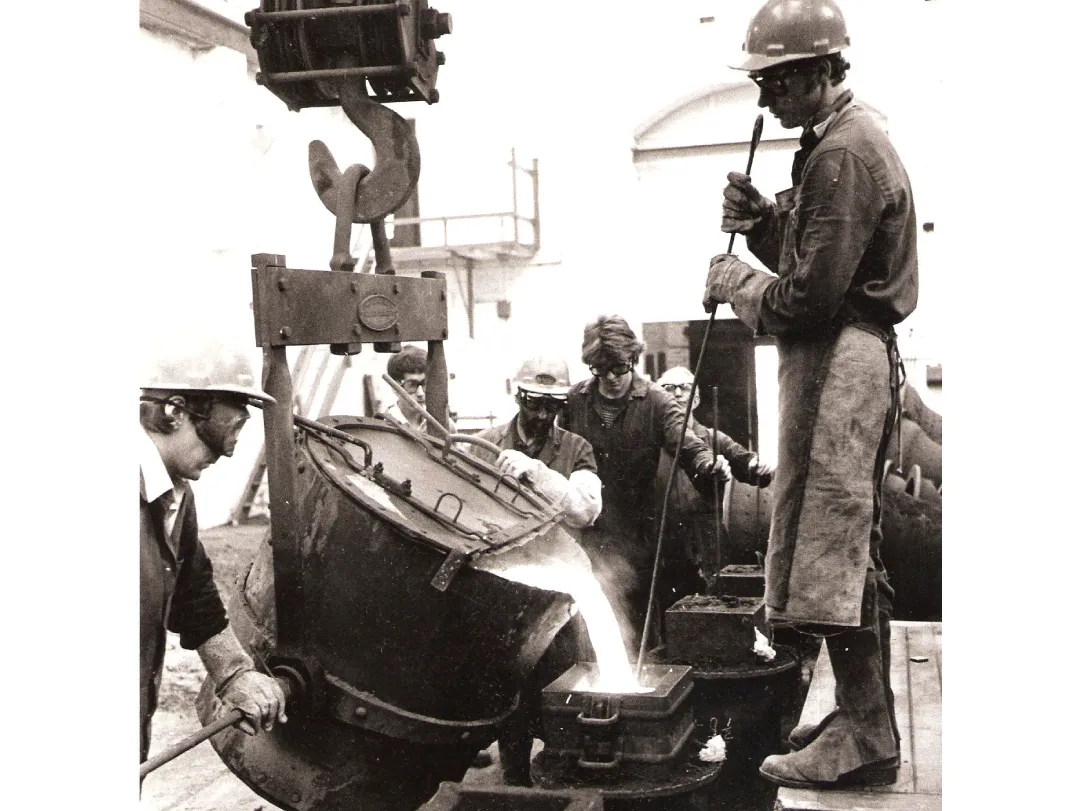
Casting bells in 1980. I am third from the left tilting the ladle and Roger Johns, far right, is holding a stopper that covers the hole into the mould. It is released every time the runner box is full.
Photo: David Humphrey.