


The Bellfoundry has been a significant presence in Loughborough for 187 years. During that time many people have worked for Taylors or had contact with us as suppliers and associates. So it’s not surprising that lots of local families have ‘bits and pieces’ to do with The Foundry. It’s always interesting when people bring things in to show us and tell us the stories of their family connections with Taylors – and we’re pleased to be allowed to copy things or accept suitable donations to the museum and archive. Three recent instances come to mind.
Gail Barby visited us on a tour recently and it made her wonder if we might like to have a document in her possession. It’s now in our archive (ref: EC 31). Leonard Bentley, Gail’s great-grandfather, served an apprenticeship with Taylors as an iron turner and fitter from 1900 to 1904. The document is the apprenticeship indenture dated 27 March 1900, drawn up by family solicitor Owen Jemson Taylor (younger brother of J.W. (jun) and E.D Taylor). It sets out the terms of his employment – working hours (54 per week) and a rising scale of pay during the term of his training. Taylors provided lodging and meals. The indenture is on a pro forma with pre-printed clauses – standard in apprenticeships from the eighteenth century or earlier – forbidding the apprentice to marry, play cards or dice or to haunt taverns and playhouses. It’s an excellent addition to the archive.
Leonard didn’t stay with us for long. He isn’t mentioned in the earliest surviving wages book in 1909 and the 1921 census shows that by then he was working at “The Brush” as an engineer’s fitter. By 1939 he was employed somewhere as an aero engine fitter. A little background research to establish the context for such historical documents is always part of the archive documentation process.
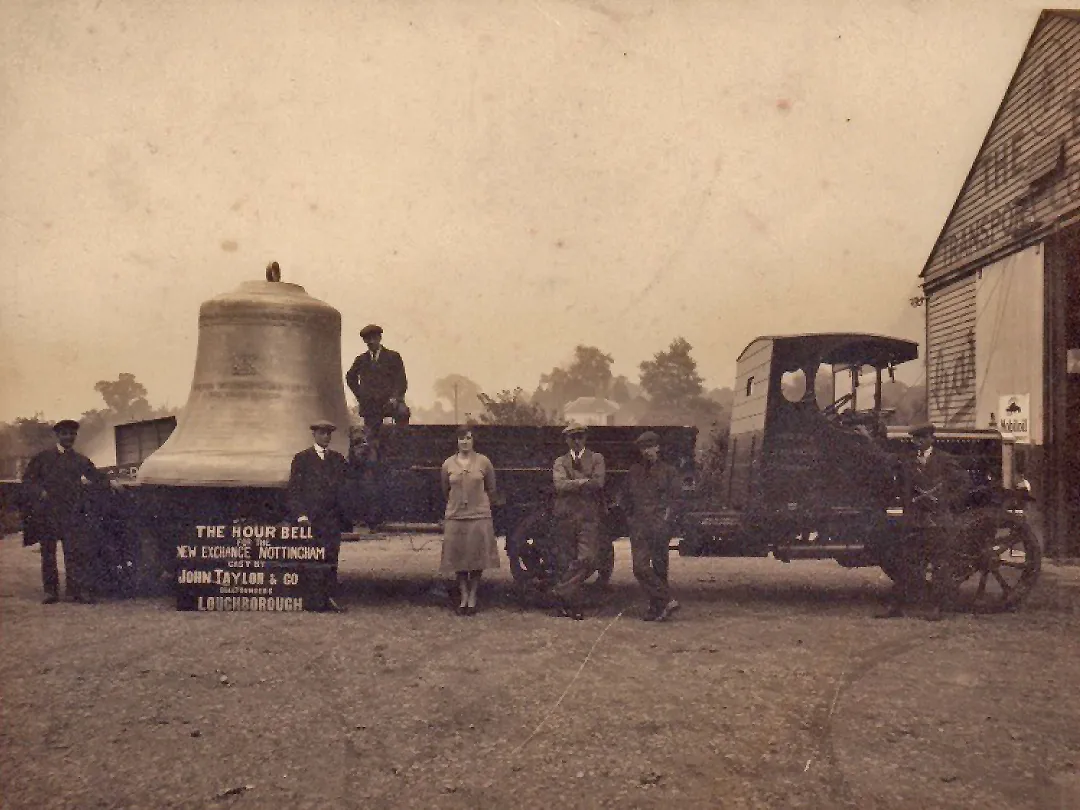
Another recent donor was David Phillips from Herefordshire. His grandfather, Walter Oxbrough, had worked for the Bee Transport Company and, later on, co-owned the Loughborough Transport Company. Both firms carried bells for Taylors in the 1920s and 1930s and David’s family photograph collection includes pictures of some of these (ref: EC 30/1-8). Walter was clearly proud of these jobs – and rightly so. He successfully transported the old “Great Peter” from York Minster to The Foundry and delivered the new bell in 1927, and in the following year carried “Little John” to Nottingham Council House. These are all bells weighing 10 tons each. Then in 1937 Walter’s firm delivered 7 ton “Hosanna” to Buckfast Abbey in Devon.
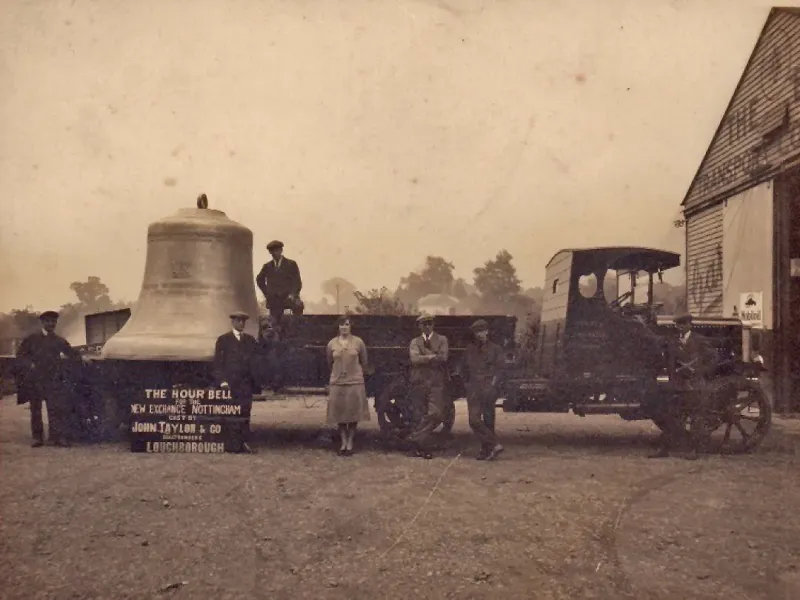
“Little John” outside the Bee Transport garages in Loughborough, 1928
There is also a picture of Walter unloading the new ring of six delivered to Harston in Cambridgeshire in 1938. These pictures add to others in the actual foundry archive, including one of Bristol University’s 10-ton “Great George” on a Bee Transport lorry and the ring of twelve for Trowbridge on a Loughborough Transport vehicle in 1934. When they came to deliver the photographs David and his wife Caroline looked at our sales daybooks of the period and found several other bell transport jobs done by Walter’s firm.
Rob Stinchcombe’s grandfather and great-grandfather were both long-serving employees and key members of the Taylor workforce. Samuel Smith (1859-1927) was a carpenter and bellhanger, living in Freehold Street at the time of the 1891 census. His son William (1892-1979) followed in his father’s footsteps and was working for Taylors by 1905. Both were ringers. Between them they installed Taylor bells at a great many churches up and down the country and Rob has a wonderful photograph album that documents some of these. Samuel and William are both in a photograph with the bells at Wrenbury near Chester in 1912. As well as the bell photographs the album also contains postcards sent from churches where William was at work.
Rob kindly loaned us his album for copying – along with William’s peal book (1910-1939) – so we have a nice little record (ref: EC 25/1-2) of his family’s involvement with the company. We were able to add to Rob’s knowledge of that side of his family history and it was good fun to undertake a little detective work to identify some of the uncaptioned photographs.
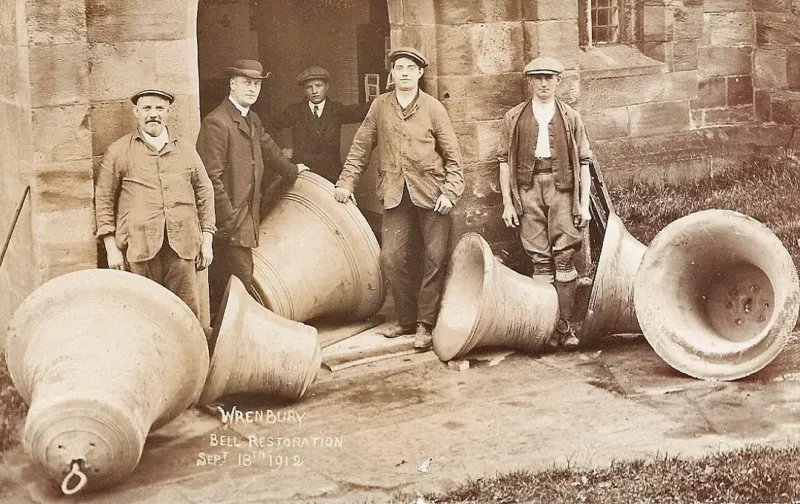
Samuel Smith (left) and young William (second from right) at Wrenbury, 1912
Taken together these “attic to archives” stories give a fair idea of the sort of material we are anxious to acquire and how they are researched, catalogued and identified to make them part of the collection. We are very grateful to all the donors. The personal stories of the people whose ancestors worked with us add a “living legacy” value to what would otherwise just be dry documents and photographs.
Author: Chris Pickford (April 2026)