


The definition
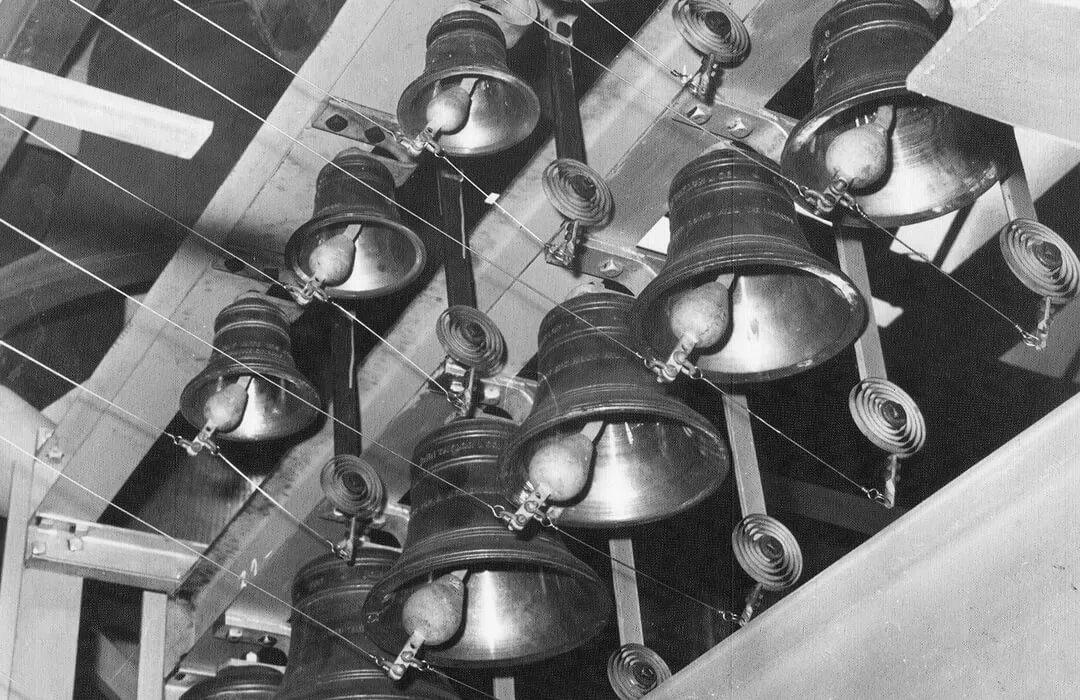
A carillon is a set of stationary bells played manually by a “carillonneur” from a “clavier”, with batons and foot pedals that strike the bells with a rigid wire linkage to the clappers.
The range of bells has to be minimum of two musical octaves which is 25 semitones, (the black and white notes on a piano). Three octaves are 37 semitones and four octaves are 49. However, in 1640 a Dutch bellfounder pointed out that the first semitone bell above the largest (bourdon bell) was hardly ever used in normal music. He suggested that in music composed specifically for a carillon they didn’t use this note. If this bell was omitted it saves metal, the cost, and space in the tower. If a bourdon bell weighs 10 tons, not having the next semitone bell saves almost 8.5 tons of metal, and the money could be used to have additional bells at the top end.
Sometimes, a second bell two semitones higher was left out as well for the same reason. If there are only 23 bells because two have been left out, they still span two octaves from the largest bell to the smallest one, so it is still a carillon. This also applies to 35 bells instead of 37 and 47 bells instead of 49. At present, the 1904 Taylor carillon beside the works is being completely re-instated with 47 new bells, not 49, so the two semitone bells have been left out.
The Transmission
Apart from the bells, the most important item, called the “transmission”, is the linkage from the clavier to the bells. Taylor’s used a series of long horizontal round bars with levers in line with the vertical wires that come up from the clavier, one rod for each bell.
Pushing down one of the batons or foot pedals pulls the lever down. On the same rod, another lever with a rigid wire goes directly to the clapper. When the first lever is pulled down, this second lever pulls the clapper across to strike the bell. With large bells with very heavy clappers, the clapper comes off the bell under its own weight when the baton or pedal is released. Smaller bells have a return spring that is tensioned when the clapper hits the bell, and when the baton is released the return spring quickly restores the clapper to its normal position.
Taylor’s continually improved the transmission and eventually used stainless steel wire and low friction ball bearing races at the ends of the rods that were now made from polished steel. This made Taylor carillons the “Rolls Royce” of carillons, but sometimes their quote for a new one was not competitive.
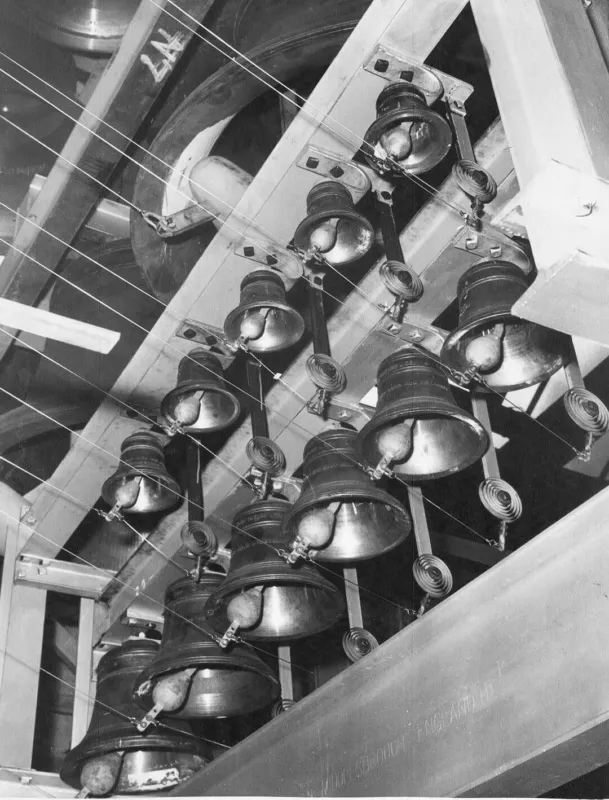
A view of the small bells of a carillon assembled in the works, showing the clappers and their return springs. Photo Taylor archive.
The Framework
All medium to large carillons have a substantial steel girder framework that may be 25ft square, often the same height, and Taylor carillons are completely assembled in the works, including the clavier, so they can be played before being shipped off. A very competent carillonneur may be invited to give a recital and sometimes donors would come to see exactly what they were getting.
Taylor employees erect the carillons at the chosen location which can take several weeks, depending on the size. Sometimes they were building two carillons in the works at the same time, and in 1927 they were building the 49-bell carillon for Sydney University and a 47-bell carillon for Cranbrook in Michigan. This must have been extremely difficult as regards space, when they were still carrying out normal bell work.
In 1928 a 35-bell WWI memorial carillon for Bathurst in Australia was dismantled and waiting to be despatched. As the tower was far from being finished, they couldn’t send it off and free up the space, and it was finally installed in 1933.
1895 to 1904.
When the Taylor family found out how to produce bells that were perfectly in tune in 1895, they had been to Holland and Belgium to look at bells and soon discovered that carillons were very popular.
They realised that they could produce them and became very friendly with a famous carillonneur, Jef Denym, from Mechlin in Belgium. In 1904 Taylor’s built a small experimental carillon beside the works in a custom-made campanile with a clavier of their design and Jef Denym came to give a series of recitals.
1909 to WWI
In 1909, through an agent in Holland, they supplied a two-octave carillon at Appingedam, and in 1913 they replaced the Dutch Vlissingen (Flushing) carillon, destroyed in a fire, with 33 bells. In 1914 they made a 25-bell carillon for Eindhoven. They were providing perfectly tuned carillons with an excellent transmission in Holland, the birthplace of carillons.
Post WWI to 1926
After WWI they supplied 39 bells to Armagh in Ireland in 1920, and Taylor’s received a letter from Anton Nauwelaerts, the carillonneur from Bruges in Belgium, who had been invited to play three recitals a day for four days. He wrote, “It is really a pleasure to play on such a carillon as all the bells are so well tuned, with such a perfect mechanism and easy moving keyboard. Every clapper responds as he is commanded. I really am jealous of the man who always has to play here”.
John William Taylor died in 1919, and his brother Edmund Denision Taylor took over. In 1921 they supplied 49 bells for Rotterdam with a four-ton bourdon bell, the heaviest Dutch carillon for over 100 years. In 1922 they made a 37-bell War Memorial carillon for the Parkside Mostyn school in the UK.
There were no carillons in North America, although there were a lot of chimes with only a few bells. Carillons became very popular as War Memorials and for universities, where pupils could learn to play them.
In 1922, they dispatched a 23-bell carillon for Gloucester in Massachusetts and in 1923 they provided the WWI Memorial carillon in Loughborough in a new 152ft tower with four-octaves and a bourdon bell weighing 4-tons. Jef Denym came to give the opening recital. During the war, three of John William’s sons were killed and the only other son, Price Taylor, returned to work at the foundry. Edmund Denison donated the 4-ton “Denison” bourdon bell in memory of his three nephews.
They sent 32 bells to Cape Town City Hall in 1923 to extend some existing bells, and in 1926 they sent a three-octave carillon to Zutphen in Holland. Between 1922 and 1926, they supplied carillons in America at Andover, Birmingham in Alabama, Morristown, New Jersey and Philadelphia.
Edmund Denison commented to a friend of his, “I am capturing the thirsty market in North America, Australia and South Africa” (as well as in Holland).
1927 to WWII
In 1927 Price Taylor was in Canada looking for carillon orders, but he died from peritonitis aged 36. The same year they sent 49 bells to Albany City Hall, a very important WWI Memorial carillon with a five-ton bourdon bell, and a 49 bell “flagship, state of the art” carillon to Florida in 1928 with a 10-ton bourdon bell.
In the US in 1928 they put import tariffs on a wide range of goods, supposedly to help their own companies, including 40% on carillons. The millionaire who paid for the Florida carillon had to pay 35,000 dollars in tax. In 1931, a Senator from Nebraska managed to get the tariff on carillons taken off by pointing out that there were no bellfounders in the US who could make carillons. Consequently, they increased their proposed 35-bell Taylor carillon to 47 bells with the tax they saved.
In 1928 Taylor’s sent 49 bells to Sydney University, another WWI memorial carillon with a 4-ton bourdon bell, and 46 bells to Cranbook in Michigan. Frank Godfrey, who had trained as an engineer, joined Taylor’s in 1928 and became their chief carillon designer continually improving the design of the transmission. He travelled extensively in the US preparing quotes and supervising the installation and finally retired in 1970.
Taylor’s supplied 47 bells to St. Helens in Lancashire in 1929 with a 4-ton bourdon bell, 37 bells for Zwolle in Holland, along with 37 bells to Bathurst in Australia in 1928.
During the 1930s they supplied carillons in America at Michigan University, Duke University, Rumson, Ann Arbor, Durham, Richmond, Hartford, Luray, Lincoln in Nebraska and Indianapolis. Edmund Denison made many visits to the US until he became semiretired after Paul Taylor, aged 21, was made a junior partner in 1935. In poor health, but an extremely wealthy man, Denison died in 1947.
Nazi Confiscation
WWII stopped any carillon manufacture, and the Nazis confiscated church and carillon bells to smelt them down and reclaim the tin.
From 1941 to 1944 they seized 175,000 bells in Europe including the four Taylor carillons in Holland that were melted down and 10,000 bells from Russia. Fortunately, some of the confiscated bells were at docks at the end of the war ready to be sent to Germany so these were recovered. Finding out exactly where they had come from was extremely difficult.
After WWII
In Holland and Belgium, they gave replacement work to their own bellfounders but in 1947 Taylor’s sent a 53-bell carillon to Niagara Falls with an 8-ton bourdon bell, and an identical one to Kansas University.
They sent 53 bells to Lawrence in 1951and in1959 they made the East Lansing carillon up to 48 bells. Peter Cake became the chief carillon designer at Taylor’s in 1960 and when he retired in 2015, he had travelled to every US state except Alaska.
In 1963 they supplied a major 53-bell carillon to Washington National Cathedral with a 10.7-ton bourdon bell. Milford Myre, a famous carillonneur from the 1928 Taylor carillon at Florida gave the opening recital. He told Taylor’s, “This is the most responsive action of any carillon I have ever played”.
In 1963 they produced a 25-bell carillon for Newcastle on Tyne and in 1965 they added 43 bells to nine large ones sent to Yale University in 1921 to make it up to 52 bells. In 1967 they augmented the Ames carillon up to 50 bells, and in 1968 they supplied a 49-bell carillon for Spokane in Washington.
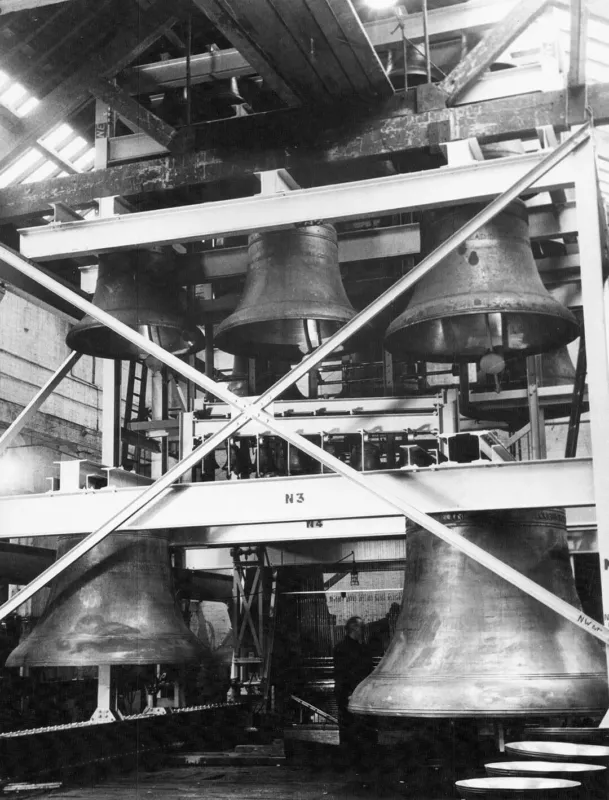
The 1963 Washington National Cathedral carillon assembled in the works. The 10.7-ton bourdon bell is at the front right. Photo Taylor archive.
In 1969 the UK government paid for a 53-bell carillon given to Canberra on the 50th anniversary of Canberra becoming the capital city. It had a 6-ton bourdon bell, the eleventh carillon that Paul Taylor had produced, and in 2019 the 5-ton “missing semitone” bell was ordered. In 2008 at York Minster, additional bells were added to eleven that they already had, making them up to 35 bells, the first traditional carillon in an English cathedral.
Replacement Bells
There had always been a problem with the smallest bells in large carillons being audible and Taylor’s doubled the number of bells in the top octave with duplicate ones, so there were 26 bells not 13, but this was never very successful. The solution was to recast the top octave with single bells that were larger in diameter, much heavier and fully audible.
In 1966 at Florida, 24 bells were recast, and in 1987 I added bells to make it up to 57. In 1970 Paul Taylor and I recast 21 bells at Richmond in Virginia and 12 single bells from Cranbook.
From 1981 after Paul died, I recast and extended Albany City Hall carillon with 30 bells. I recast and added 33 bells at Wellington in New Zealand, but it was not a Taylor carillon originally. In 1990 at Nebraska, the top octave of 26 bells was recast with another nine added and the same year Taylor’s recast 34 bells and added four more at Cohasset in the US, another carillon not made by them.
In 2011 the top two octaves at Michigan University were replaced, and in 2019 the Bathurst carillon was extended with 12 additional bells and a clavier. Similar projects have been carried out since then and there will always be orders for renovations to existing carillons, including new and recast bells, claviers and linkages.
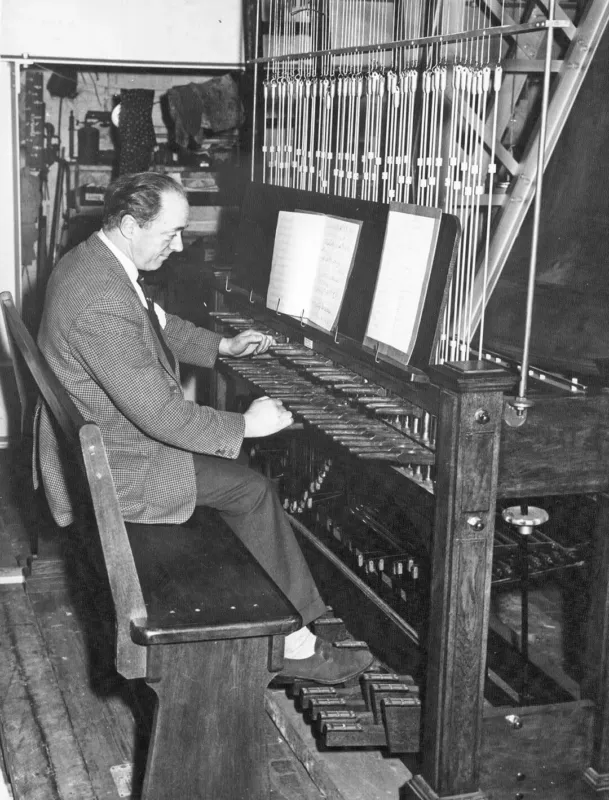
Paul Taylor seated at the clavier of the 1963 Washington National Cathedral carillon in the works, showing the batons and foot pedals he is depressing to play music. Photo: Taylor archive.
Mike Milsom